
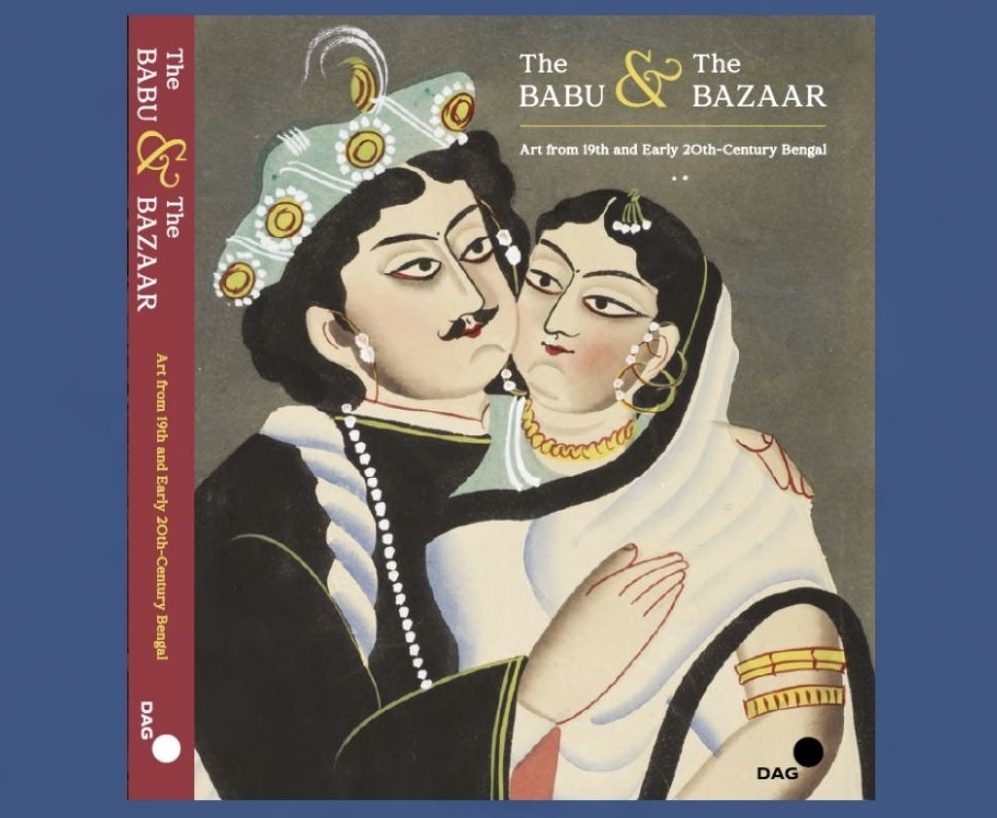
Last December, we walked through the red-brick corridors of the Alipore Jail Museum and entered an exhibition titled The Babu and the Bazaar: Art from 19th and Early 20th-Century Bengal. At first glance, it appeared to be a familiar archive of colonial Calcutta. It’s babus, courtesans, deities, print cultures, and bazaar economies. But in the visual depiction of a city’s history, what is an exhibition capable of revealing? We argue it is the suppressed story of people’s day-to-day struggle over time.
The Babu and the Bazaar: Art from 19th- and early 20th-century Bengal, curated by Aditi Nath Sarkar and Shatadeep Maitra, is a major DAG (Delhi Art Gallery) exhibition that has travelled to cities such as Mumbai and New Delhi before arriving in Kolkata. It reconstructs an urban world where class aspirations, gendered anxieties, mytho-poetic imaginaries, and the contradictions of modernity collide and converge. Bringing together Kalighat pats (scroll paintings), mass-produced prints, commissioned oil paintings, and imported visual forms such as reverse-glass painting, the exhibition showcases a spectrum of themes, ranging from moral satire to socio-political commentary. The classification of these artworks under the rubrics of Babu and Bazaar subtly stages a hierarchy of art’s value prevalent in colonial Bengal. On the one hand, the artworks embodied rarefied pursuits of elite consumption; on the other, the exhibition persistently reminds viewers of their circulation across heterogeneous spaces, from bazaars and pilgrimage routes to print shops and domestic interiors.
Sociologist Tony Bennett (1995) and anthropologist James Clifford (1997) have argued that museums are not neutral repositories of objects but active sites where histories are produced through processes of selection, juxtaposition and circulation. Premised on this idea, our collaborative efforts trace the itineraries of artworks; how their travels and the stories they accrue along the way generate meanings that do not merely comment on the past. If pursued further, this approach may provide an instrument for analysing the present. In fact, this exercise can also help us answer a broader question: What role does the museum play in shaping understandings of the past and the present? More fundamentally, how does it make particular perceptions of ‘time’ possible?
The Spectacle of Time
Nineteenth-century Calcutta, often called the “second city” of the British Empire, can be a contentious site of critical analysis. When we read the digital brochure of the exhibition, it offered us a spectacle of time in which maritime trade, colonial administration, education, and pilgrimage brought diverse populations into proximity, especially around the Kali temple at Kalighat, which was rebuilt in 1809 (DAG, 2023). It was a bustling bazaar that catered to the pilgrims and visitors with a wide variety of souvenirs, religious artefacts, and inexpensive watercolour paintings, later categorised as Kalighat pats or scroll paintings. At the same time, advances in printing technology introduced lithographs, oleographs, engravings, and woodcuts into the more urban market centres. These printed images competed directly with pat painters for the same audience by producing overlapping iconographies on similar themes. Instead of replacing one another, these forms coexisted and, to some extent, influenced one another, blurring distinctions between popular and elite art (Guha-Thakurta, 2004).
One of the most compelling figures to emerge from this visual world is the babu—the English-educated, newly affluent bhadralok, recognisable by his black coat, crisply pleated dhoti, and carefully styled hair. Within elite colonial discourse, the babu often functioned as an emblem of progress, refinement and modern outlook. In popular visual culture, however, he was rarely treated with such deference. Kalighat paintings, in particular, render the babu through sharp wit and unapologetic satire, repeatedly depicting him as foolish, morally compromised, henpecked, and publicly humiliated (Jain, 1999; Mitter, 1994). In several scenes from the exhibited paintings, domestic hierarchies are pointedly inverted as the bibi (wife) brandishes the broom at the babu. In these images, the babu’s cultivated pretensions appear to collapse under the weight of their own mimicry, exposing colonial modernity as a fragile and often comic performance. These images mock Westernisation, class aspiration, and the loss of cultural grounding, deploying popular art as a sharp form of social critique (Mitter, 1994; Pinney, 2004). The babu appears as a problematic figure, whose access to education, wealth, and privileged power generated both resentment and fascination. This critique is articulated through humour and exaggeration, where the expression of satire tends to ‘slow down’ the progressive march of elite modernity (Benjamin, 1968) by exposing its contradictions and moral fragility. Equally striking are the representations of women, particularly the figure of the sundari. Draped in translucent saris, preparing paan, absorbed in self-care, the portrayal of a sensuous, carefully groomed woman offered a visual depiction of the lives of 19th-century courtesans and sex workers in Bengal. Following the abolition of sati, many widowed women were socially abandoned and forced into prostitution. This is visually encoded through markers such as the black-bordered white sari. Oscillating between desire and domination, pleasure and vulnerability, these images reflect the harsh social realities of the period, embedded within broader structures of gendered hierarchy, the voyeuristic gaze, and moral degradation. Through deceptively simple pictorial language, these works register the anxieties of social reform in colonial Bengal (Sarkar, 1989; Guha-Thakurta, 2015).
An oil painting portrayed the Hindu deity Shiva sprawled on the ground after an inebriated mishap, while Parvati (his wife), their children, and even the lion laugh at his expense. These images capture a religious sensibility in which the divine is not to be feared but can be made fun of, with affectionate irreverence and humour. At the same time, artistic practices were shaped by emerging global and transcultural networks of the period. For instance, the faces of Radha and other female deities resemble those of Mughal queens. British techniques of shading, volume, and foreshortening were applied to mythological scenes. A hybrid visual language emerged through the depiction of Bengal’s social and political landscape, neither purely indigenous nor colonial (Mitter, 1994). The Babu and the Bazaar, therefore, has to be placed beyond dialectic nostalgia, precisely in its insistence on art as social, political and moral critique, where Kalighat painting emerges as a form of expression and the division between elite and popular art, the sacred and the profane, was continually negotiated along the lines of class, gender and religion.
The City as Clock
On the same day of our museum visit, we travelled to Patuapara, a historic neighbourhood in Kalighat, long associated with patuas, or scroll painters. Walking through its narrow lanes for nearly an hour, we found no trace of the artisans whose works now circulate as preserved historical artefacts. A local policeman did not recognise the term patua. The nearby residents directed us to a shop. This was reportedly the last in the area still selling pat paintings. This neighbourhood, known for its pioneering status, bore little material trace of that legacy. We crossed into Kalighat Road, adjacent to the temple. We noticed hundreds of pandas (priests) moved through the crowd, bargaining and offering expedited darshan of goddess Kali through VIP gates. They promised to bypass the long queues faced by ordinary devotees. As we moved farther from the exhibition’s physical site, the museum continued to accompany us. It revealed to us a political economy of time embedded in the ritual of darshan (Eck, 1998). The sacred idol of goddess Kali had been transformed into a cosmic artwork, accessible through the gates of privilege and power by some, and through the experience of waiting, longing, and delay, by others.
The city itself began to function as a museum, and the exhibition was no longer a bounded site of display. Instead, it acted as a dispersed field in which art, aesthetics, devotion and commerce continued to mutate across urban space. What struck our attention, however, was how time became the primary commodity in circulation. In this context, what is purchased is accelerated visibility. Quickened darshan, streamlined movement, and doors that open briefly, allowing a restricted group of individuals to reclaim time. Time is imagined as scarce and valuable. It is something to be saved, optimised and efficiently managed. In the modern regimes of speed, productivity and calculability (Virilio, 2006; Rosa, 2013), the satirical depiction of class distinctions on canvas reappears in the streets of Kalighat. What we seek to foreground is not how the past reappears in the present, but a horological grammar that both shapes and is shaped by polymorphous expressions of time.
Hermeneutics of Time
Karl Marx (1867) conceptualised modernity as the birth of an abstract, homogeneous time, central to capitalism. In Capital: A Critique of Political Economy (1867), Marx shows how labour time becomes the measure of value and how capitalist modernity transforms time into a quantifiable, extractable and exchangeable entity. E.P. Thompson’s classic essay Time, Work-Discipline, and Industrial Capitalism (1967) historicises this shift by showing how industrial capitalism reorganised everyday life by imposing clock-time over agrarian, seasonal, and event-based understanding of time. This replacement of task-oriented time with clock-time produces what Max Weber (1930) saw as the “iron cage” (Weber, 1930: 181) of calculability and efficiency. It is rational-bureaucratic time, often measured and evaluated in terms of speed and velocity.
The notion of speed as a defining feature of modernity is most explicitly theorised by cultural theorist Paul Virilio (2006), who argued that modern forms of power operate through dromology, i.e., the logic of speed. For Virilio, acceleration produces new forms of inequality and catastrophe. This conception of modernity as a condition of social acceleration has been expanded by sociologist Hartmut Rosa (2013), who argued that speed becomes a commodity insofar as faster circulation promises productivity and competitiveness. While thinkers like Virilio (2006) and Rosa (2013) theorise speed as the defining force of modernity, historian Prathama Banerjee (2020) is attentive to how acceleration is unevenly inhabited. Banerjee (2020) suggests that speed is not a universal condition but a historically situated form of orientation that constitutes perceptions of urgency, delay, mobility and waiting (Banerjee, 2020: 27 and 211). Colonial and postcolonial subjects often experience modern time through multiple temporalities, some marked by suspension and deferral (Banerjee, 2020: 46), and others by repetition (Banerjee, 2020: 68). This complicates the idea of speed as a generalised commodity.
Banerjee (2006) engages critically with Marxist, Weberian, and postcolonial accounts of modern time by questioning the assumption that modernity necessarily installs a single dominant temporal regime (whether capitalist, bureaucratic, or colonial) against which other temporalities merely “survive” or “resist” (Banerjee, 2020: 79-85). In our understanding, there is a particular grammar through which time, history, and modernity are conceptualised, particularly in South Asia. Banerjee (2006) reorients debates on modern time by showing that colonial and postcolonial modernity in South Asia is not organised around a singular accelerated temporality, but through unresolved, cohabiting, and ethico-affectively charged temporal forms that neither collapse into linear progress nor stand outside modernity (Banerjee, 2020: 195). Where scholars like Johannes Fabian (1983) and Dipesh Chakrabarty (2000) argue for the recognition of multiple temporalities, Banerjee pushes further by interrogating the modern concept of history itself. She argues that modern historiography, whether nationalist, Marxist, or colonial, rests on a temporal abstraction that separates past, present, and future too neatly. However, time in the intellectual and political life of the Indian subcontinent often appears as an eventful, ethical, and moral force, culminating in different historiographical practices (Banerjee, 2020: 43). Similar analytical perspectives can be found among anthropologists who argue that time is not merely an external or objective measure but a lived medium through which social meaning is produced (Gell 1992; Munn 1992; Bear 2016).
Inside the temple, an unknown visitor standing in the queue beside us, made a passing remark.
Darshan tokhon’i hobe jokhon maa chaiben
Maa na chaile darshan pawa jay na
Koshto na korle ki keshto mele?
Darshan happens only when the Goddess wills it.
If the Goddess does not wish, darshan does not take place.
Without pain and suffering, there is no divine reward.
These remarks articulate a popular perception within the devotional lifeworlds of the Shakta tradition[1], where the exhibition of the goddess is understood as a cosmic moment that cannot be secured through the power of purchase. Instead, it is the endurance of pain and longing that summons the call of the divine. The act of waiting is thus repurposed through a socio-cosmic imagery of time, in which idioms of pain and suffering become tools of reclaiming agency (Asad 2000). Standing in long queues and enduring heat, congestion and uncertainty, devotees come to inhabit time. Through prolonged waiting, time settles into the body; it thickens the density of devotional labour and renders the subject available for darshan. In this sense, delay becomes an ethico-affective register through which the cosmos exhibits itself.
As the exhibition draws to a close, the artworks encased in their vitrines, might not continue to showcase this complex circuitry through which multiple pasts and presents co-constitute one another. However, the exhibition lays bare two, or perhaps more, competing temporal logics that co-exist in the city of Kolkata. Time as capital and time as cosmos. This raises an important question. Which temporalities are preserved, recorded, or circulated, and which of their underlying logics become embedded in the everyday practices of ordinary people? By activating this tension, The Babu and the Bazaar invited viewers like us to peer into the city’s intricate clockwork and the politics of waiting.
References
Asad, Talal. Genealogies of Religion: Discipline and Reasons of Power in Christianity and Islam. Baltimore: Johns Hopkins University Press, 2000.
Banerjee, Prathama. Politics of Time:’primitives’ and History-writing in a Colonial Society. Oxford University Press, 2006.
Banerjee, Prathama. Elementary Aspects of the Political: Histories from the Global South, Durham and London: Duke University Press, 2020
Bear, Laura. “Time as Technique.” Annual Review of Anthropology, 2016, 45: 487-502.
Benjamin, Walter. “Theses on the Philosophy of History.” In Illuminations, edited by Hannah Arendt, translated by Harry Zohn. New York: Schocken Books, 1968.
Bennett, Tony. The Birth of the Museum: History, Theory, Politics. London: Routledge, 1995.
Chakrabarty, Dipesh. Provincializing Europe: Postcolonial Thought and Historical Difference. Princeton: Princeton University Press, 2000.
Clifford, James. Routes: Travel and Translation in the Late Twentieth Century. Cambridge, MA: Harvard University Press, 1997.
DAG, The Babu and the Bazaar: Art from 19th and Early 20th Century Bengal, DAG World website, https://dagworld.com/the-babu-and-the-bazaar.html
Eck, Diana L. Darśan: Seeing the Divine Image in India. 3d ed. New York: Columbia University Press, 1998.
Fabian, Johannes. Time and the Other: How Anthropology Makes Its Object. New York: Columbia University Press, 1983.
Gell, Alfred. The Anthropology of Time: Cultural Constructions of Temporal Maps and Images. Oxford: Berg, 1992.
Guha-Thakurta, Tapati. Monuments, Objects, Histories: Institutions of Art in Colonial and Postcolonial India. Columbia University Press, 2004.
Guha-Thakurta, Tapati. In the Name of the Goddess: The Durga Pujas of Contemporary Kolkata. New Delhi: Primus Books, 2015.
Jain, Jyotindra. Kalighat Painting: Images from a Changing World. Ahmedabad: Mapin Publishing, 1999.
Marx, Karl. Capital: A Critique of Political Economy. Volume I: The Process of Production of Capital. Translated by Samuel Moore and Edward Aveling, edited by Frederick Engels. Based on the first English edition of 1887. Originally published in 1867.
Mitter, Partha. Art and Nationalism in Colonial India, 1850–1922. Cambridge: Cambridge University Press, 1994.
Munn, Nancy D. “The Cultural Anthropology of Time: A Critical Essay.” Annual Review of Anthropology, 1992, 21: 93–123.
Pinney, Christopher. Photos of the Gods: The Printed Image and Political Struggle in India. London: Reaktion Books, 2004.
Rosa, Hartmut. Social Acceleration: A New Theory of Modernity. New York: Columbia University Press, 2013.
Sarkar, Sumanta. The Parlour and the Streets: Elite and Popular Culture in Nineteenth-Century Calcutta. Seagull, 1989.
Thompson, E. P. Time, Work-Discipline, And Industrial Capitalism, Past & Present, Volume 38, Issue 1, December 1967, Pages 56-97.
Virilio, Paul. Speed and Politics: An Essay on Dromology. Translated by Mark Polizzotti. Los Ángeles: Semiotext(e), 2006. Originally published in 1977.
____________
[1] The Shakta tradition is a branch of Hinduism devoted to the worship of the Goddess (Devi) in her many forms, centered on the concept of shakti or the power of the feminine divine.